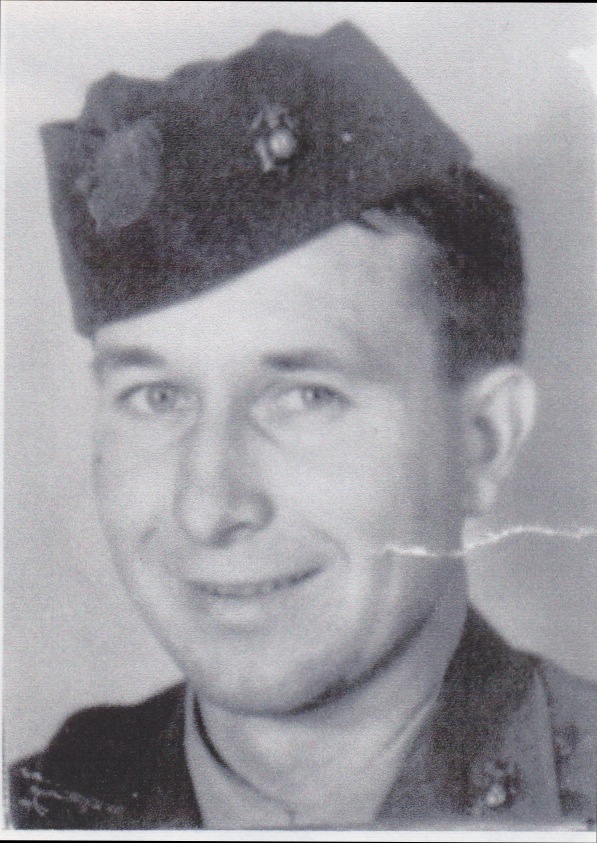
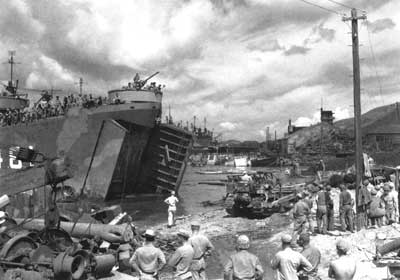
Great-Uncle LaRoy enlightened me with more details about my grandpa, his brother. Calvin Muir Hooper served as a machinist on the USS Cape Gloucester CVE-109)

As a marine with knowledge of machinery, Grandpa served on a naval escort carrier. They were developed originally by the British to give antisubmarine aircraft places to land. The USS Cape Gloucester was a Commencement Bay class, sent to the Pacific.
"The Commencement Bays were completed in 1944-45 as the final class of escort carriers. They were a development of the Sangamons, and inherited many of their characteristics, but were built as carriers from the keel up. They had less range, but much better machinery layout and subdivision. Many warship experts regard them as the best of the escort carriers. Only a few units were completed in time to see combat and none were lost in the Pacific."

http://www.navsource.org/archives/03/109.htm The USS Cape Gloucester seen from various angles. At port in Pearl Harbor.
"The Commencement Bays were completed in 1944-45 as the final class of escort carriers. They were a development of the Sangamons, and inherited many of their characteristics, but were built as carriers from the keel up. They had less range, but much better machinery layout and subdivision. Many warship experts regard them as the best of the escort carriers. Only a few units were completed in time to see combat and none were lost in the Pacific."
(http://pwencycl.kgbudge.com/C/o/Commencement_Bay_class.htm)
It sounds as though they weren't the most enjoyable ships, as the crewmen joked that "the type designation (CVE) stood for 'Combustible, Vulnerable, and Expendable.' They were cramped and uncomfortable, and flight operations were always hairy. Nevertheless, the ships were a success."
(http://pwencycl.kgbudge.com/E/s/Escort_Carriers.htm)

The ship as a whole was awarded a battle star at the end of World War II.

CVE-109 GENERAL SPECIFICATIONS
http://www.hullnumber.com/CVE-109
If I'd been in Grandpa's place, I'm sure I'd have been jumping each time one of the pilots knocked a kamikaze out of the sky. I just wonder how his emotions shifted when they reached Nagasaki, seeing the damage and the prison camp POWs.
I'm proud of my grandpa, Calvin Muir Hooper, who served as a marine during World War II. The men in the POW camps survived so much, such as starvation, extreme work and exercise, and seeing friends and soldiers tortured and killed. I'm grateful for all of the heroic efforts of the members of the military serving aboard the U.S.S. Cape Gloucester.
It sounds as though they weren't the most enjoyable ships, as the crewmen joked that "the type designation (CVE) stood for 'Combustible, Vulnerable, and Expendable.' They were cramped and uncomfortable, and flight operations were always hairy. Nevertheless, the ships were a success."
(http://pwencycl.kgbudge.com/E/s/Escort_Carriers.htm)

Calvin Muir Hooper
Enhanced with Photoshop
The ship as a whole was awarded a battle star at the end of World War II.
After operational training at Pearl Harbor, Cape Gloucester arrived at Leyte, P.I. on 29 June 1945 to join the 3rd Fleet. Her planes flew combat air patrolfighting off Japanese kamikazes attempting to attack minesweepers operating east of Okinawa from 5–17 July. They then took part in air raids and photographic reconnaissance of shipping and airfields along the China coast until 7 August. During this time, her aircraft shot down several Japanese planes, and aided in damaging a 700-ton cargo ship. After a period covering minesweeping along the Japanese coasts, and just two weeks after the Japanese formally surrendered on board the U.S.S. Missouri on September 2, 1945, the Cape Gloucester sailed into Nagasaki, stripped of her planes, to serve as an early participant in the celebrated “Magic Carpet” fleet that returned thousands of ragged and half-starved prisoners of war from Australia, New Zealand, Britain and Holland, together with a handful of Americans, to their homes. Many of these POWs were from prison camps on Kyūshū. In that role, Cape Gloucester sailed to Okinawa to unload the allied POWs, and made four voyages returning U.S. servicemen from Okinawa and Pearl Harbor to the west coast. The escort carrier returned to Tacoma, Wash., 22 May 1946, and was placed out of commission in reserve there on 5 November 1946. Still in reserve, she was reclassified CVHE-109 on 12 June 1955, and further reclassified AKV-9 on 7 May 1959. http://en.wikipedia.org/wiki/USS_Cape_Gloucester_(CVE-109)
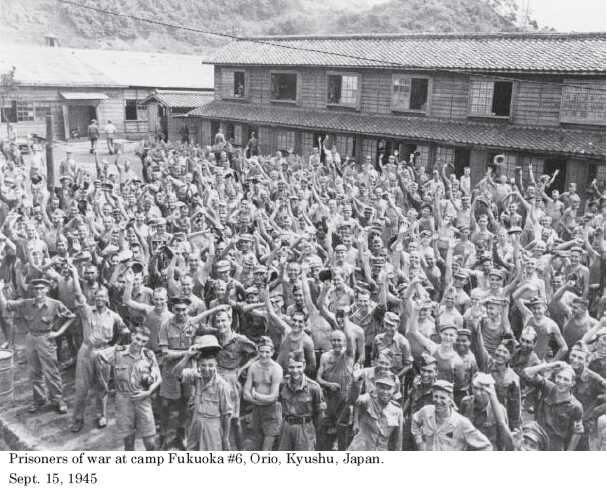
http://www.japanfocus.org/site/view/1627
CVE-109 GENERAL SPECIFICATIONS
Class: Commencement Bay-class escort carrier
Complement: 1066 Officers and Enlisted
Displacement: 10900 tons
Length: 557 feet
Beam: 75 feet
Draft: 32 feet
Final Disposition: Sold and scrapped (1971)
http://www.hullnumber.com/CVE-109
If I'd been in Grandpa's place, I'm sure I'd have been jumping each time one of the pilots knocked a kamikaze out of the sky. I just wonder how his emotions shifted when they reached Nagasaki, seeing the damage and the prison camp POWs.
I'm proud of my grandpa, Calvin Muir Hooper, who served as a marine during World War II. The men in the POW camps survived so much, such as starvation, extreme work and exercise, and seeing friends and soldiers tortured and killed. I'm grateful for all of the heroic efforts of the members of the military serving aboard the U.S.S. Cape Gloucester.